If one removed the country names and just looked at where investment (focus, planning, and money) was, we would see two greatly different pictures.
One country is disincentivizing or even blocking renewable energy production, rolling back climate protection measures, trying to revitalize the coal industry, slashing investment in scientific research of all kinds, demonizing higher education, and spending vast and rapidly increasing amounts of public funds to create direct, physical conflicts.
Another country is increasing their renewable energy generation capabilities dramatically each year, encouraging EV adoption, investing very heavily in scientific research, and also investing in military (although without initiating direct physical conflicts).
One of these two countries is riding on momentum, but the drag from waste and mismanagement of resources is increasingly slowing it. The other country is building momentum while reducing drag.
The difference in these approaches will be obvious in a decade, and in two decades one of the two countries will be just another chapter in a book about the rise and fall of empires.
While I agree with your overall point, I'm reminded of "the market can stay irrational longer than you can stay solvent" here. The US is a huge economy with a massive military infrastructure. I don't think it's fading to fallen empire status that quickly.
1910 The UK is the biggest, most powerful empire the world has ever seen.
1950 The UK is not that or anything like it.
Today. Does anyone really care much about what the UK says or does on the world stage? Ordinary British are better off now than 1910 and it isn't close.
So what you say is obviously true as long you define "quickly."
Plus the Japanese beating the British so badly all over Southeast Asia. This gave a lot of momentum to independence in Philippines, Indonesia, Thailand and eventually India.
Hopefully. With that said, when a country makes too many poor decisions, independently or relative to other countries, it'll eventually bite them in the butt.
It’s going to be a multi-polar world. The US will continue to be among the top powers for decades to come. We’re simply exiting an unusual period where China isn’t leading/among the leading pack of countries.
The rate of US relative decline will be set by our policy decisions and cohesion. As we are apparently electing malicious narcissists with dementia to our highest office, a more precipitous decline seems reasonable
I think what you will see is what happens in the body when it becomes starved - it will start eating itself.
We have already begun to see this. The middle class is no longer expanding, nor is the poor (by meaningful terms). Worse, the poorest class - largely made up from immigrants - legal or otherwise - are being driven away.
Life in the US has been relatively comfortable for a few generations now. So current healthy (age-speaking, not fitness) generations have no idea how to revolt. Ironically, we may see change come from the southerners with guns who eventually decided they had been deceived by the people they voted for. After all, both sides cowered on Jan 6. Just imagine if "representing your constituents" was a do or die scenario. The US is mostly far from that scenario if a supreme leader is not directing the masses.
Unfortunately, as with many other fallen empires, I think it will take a LONG time for things to recover. The idealistic principles which the US claimed to be founded upon are largely not present now - the freedom from oppression, the freedom of/from religion, and the concept of fair representation.
> As we are apparently electing malicious narcissists with dementia to our highest office, a more precipitous decline seems reasonable
To be fair, the current political dysfunction can probably largely be reduced by switching the electoral system from 'first past the post' + electoral college to something like ranked choice or proportional representation.
> In political science, Duverger's law holds that in political systems with single-member districts and the first-past-the-post voting system, as in, for example, the United States and United Kingdom, only two powerful political parties tend to control power.
> By contrast, in countries with proportional representation or two-round elections, such as France, Sweden, New Zealand or Spain, there is no two-party duopoly on power. There are usually more than two significant political parties.
and that way the presidential election does reflect "either the will of the Democratic Party elite or the will of the Republican Party elite" (ie, the extremes of the two main parties), but something closer to the will of the people.
I may be misinterpreting your comment, so forgive me if I am.
When Trump began the trade wars (tariffs), it caused many countries to reconsider their alliances and operations. What you can see is a great shift away from the USD in many areas. This is not temporary, or at least not short-term.
Once trade alliances are formed between parties that exclude the US, those groups seek financial paths which are more stable and unrelated to the volatile path they previously took.
As for the EU, they have an insane task: trying to provide fairly equal voice to a large number of stakeholders. EU was a very idealistic concept, and I'm surprised it made it this far. But they should not be discounted. They may be slower to react to situations by virtue of their necessary processes, but they will eventually get it.
Europe is wisely waking up and starting to loosen its military dependence on the US. Hopefully they are/will do the same when it comes to medical research since the US has been taken over by anti-vaxxers.
I’m saying this as a non European. I’m an American who is making plans to split my time between the US and Costa Rica (here now) and maybe Panama and would love to see them become close to Europe politically.
> Hopefully they are/will do the same when it comes to medical research since the US has been taken over by anti-vaxxers.
Aren't European companies already very competitive in drug development and Medical devices? Philips practically owns the ultrasound markets globally -- Novo Nordisk, GSK, Bayer, Merck, seem competitive too.
US has fossil energy and its actually on the front lines in innovation including green energy, so it will probably be fine. IMHO the main risk would be whatever hapen to the Japanese mobile phone industry happening to US. That is, US will probably end up developing lots of very cool US specific tech that people will talk about how impressive it is but no one will be interested in actually buying it because everyone else will have moved on.
I think this discounts the nature of the threat. American science has been systematically gutted and will be rebuilding for a generation even after it stops, and we’re seeing a lot of effort to put anti-competitive measures in place: from blocking deployment of green energy and removal of EV chargers to forcing fossil fuel infrastructure choices which lock in fossil fuel-based industrial processes for a decade. Japan’s phones were both very unusual, not repeated much elsewhere (due to language support) and they had a world-class electronics industry backing that, whereas ours was moved to China to save on labor costs.
We’re not developing cool tech if we don’t have the industrial capacity to make it or a domestic market. We’ll just get poorer and further behind.
I'd say it's a closer race and the end is not a foregone conclusion yet. That one country currently exhibiting some very troubling tendencies also has more robust self-healing mechanisms in the form of democracy. It has gone off course in the past too but then found its way back. That said, those self-healing mechanisms are under attack as well so there is at least some suspense in the long term outcome
I'd love to share your optimism and trust in that country-that-shall-not-be-named's self-healing mechanisms, but its system is already centuries old and based on a sort of "gentleman's agreement" that each of the powers in the state will respect the others. To make things worse, since WW2, the executive has amassed more and more power which a sufficiently unscrupulous president can use to start an authoritarian takeover. Currently, the only hope I see is that enough people are fond enough of their democracy (even if only because that's what they grew up with) to stand up for it when push comes to shove...
A major problem facing that nation is that not many people are particularly interested in maintaining a democracy. They just want to see the “other team” lose.
This is not how the adult world works, and we are all in organizations to know how difficult it is to spin up teams, and get them to a degree of excellence.
America with project 2025 has basically been burning libraries of experience, and it’s not going to come back without decades of slow, painful work to rebuild it.
Since this concept is only visible to people who think and have seen organizational decay, it is going to have a minor impact on the zeitgeist.
Instead voters are going to wonder every year why things aren’t better, not be interested in the boring institution building, and will vote whatever sounds good.
Underpinning all of this, the fundamental flaw that is laying all democracies low, is the challenge of managing our information economies.
We’ve developed ways to pollute and control our speech that don’t involve government control. We have information and media ecosystems that shape discourse by embracing abundance. Our legacy social defenses are “more speech = more good”, and so we have no new ideas how to deal with this new feature of modern life.
The other factor is the increasing concentration of wealth, resulting in those elites being the only voters that count, since they end up consolidating power. The top few households matter more to the economy than everyone beneath them.
These are the two big challenges that we have to address philosophically and practically for the advantages of democracy to kick in again.
> One of these two countries is riding on momentum, but the drag from waste and mismanagement of resources is increasingly slowing it. The other country is building momentum while reducing drag.
Let's not stop at the two biggest economies: the US and China. Let's add the EU to the mix. The EU saw, inflation adjusted in USD, hardly any growth since the 2008 financial crisis to now. While both the US and China's GDPs grew like crazy.
I agree that China atm is doing something very right but if you believe the US not on a good path, you should look at the EU. The EU has nothing but one company left in the top 50 of the biggest worldwide companies by market cap. Not that long ago the UK was the world's first superpower and France just before that.
And now my EU is headed on a path leading to third-worldness.
I think this reasoning does not work for you because the word "woke" does not mean anything bad for you.
Let's use a different derogatory word to illustrate this same point. Imagine if using renewables was associated with being "communist" or "terrorist" or "a child molester". Remember how Bitcoin is often perceived, "it's used by criminals to buy drugs and pay for hitmen, so we should not endorse it, even if it might have some good uses".
This is how about half of the country _perceives_ "woke".
I'm not saying it's a correct behavior, but that's how many people perceive it. So working on its brand and marketing is probably a good idea to disconnect the concept of renewables from the word "woke".
Renewable energy and EVs are technologies. They aren't woke, communist, or any of the other silly adjectives being applied. Conservatives are against these technologies strictly because liberals are for it. Only the dumbest people in charge.
> If one removed the country names and just looked at where investment (focus, planning, and money) was, we would see two greatly different pictures.
> ...
> The difference in these approaches will be obvious in a decade, and in two decades one of the two countries will be just another chapter in a book about the rise and fall of empires.
The interesting question is: why. I'd say the US ultimately will be judged to be another victim of the "shock doctrine" (in its case, the China Shock). In other words (at least in a democracy): letting the economists and libertarians run wild with the economy will create a backlash that will ultimately weaken it.
The supposedly smart people in charge needed to pay less attention to their pet theories, and way more attention to the common people. They didn't, and this is the result.
"Energy doesn't appear immaculately from the heavens."
It actually does. There is a big fusion reactor up there that gives us a lot of direct energy, if you don't live near the poles it is enough for everything.
Genius strategy by the USA to disincentivize EVs, disincentivize solar and wind, increase dependency on oil & gas, and...start a war that makes oil and gas more expensive for everyone. Markets are now forecasting oil prices will stay above $100 a barrel for multiple years. Best of luck to the economy.
There's a sweet spot in oil pricing that maximizes profits for producers, and $110 a barrel is well over that. If there's a recession then nobody is buying your product.
> Markets are now forecasting oil prices will stay above $100 a barrel for multiple years
It'll never go below $100 a barrel.
It went bellow $100 a barrel for the last few years because as US shale processing came online, opec decided to also keep production high which cut oil prices from $100/barrel to ~$50/barrel where it's roughly stayed for the last decade.
There's not another "new way to extract oil for cheap" technique on the horizon. Israel and Iran are both destroying oil extraction and processing facilities in the gulf region, it'll take years and a huge amount of money just to rebuild those. By the time that's finished, assuming it finishes, inflation will have firmly caused the price of oil to stay above $100.
This is basically a permanent increase. We are sort of at global warming catastrophes now. It's not a question of if it will be bad, it's a question of how long and how intense. The longer this war/military operation/regime change/whatever we are doing goes forward, the worse it will be. And, unfortunately, I don't think there's any specific goal the trump admin is trying to achieve. This is such an obvious F-up and Trump will only pull out if he can somehow make a claim that it isn't.
> Israel and Iran are both destroying oil extraction and processing facilities in the gulf region
This isn't like Katrina where oil infrastructure was being temporarily evacuated, shut down, and taking some water and wind damage.
The oil infrastructure is being blown to smithereens. And not just pumps that are sucking oil out of a hole in the ground. Refineries. Big expensive factories that process oil. Stuff we don't even bother to build in progressive parts of the world because the combination of environmental regulations and concerns about climate change mean it's possible they'll never pay off their massive construction costs.
> Stuff we don't even bother to build in progressive parts of the world because the combination of environmental regulations and concerns about climate change mean it's possible they'll never pay off their massive construction costs.
Ignoring pollution and externalities for the sake of argument this is what is very interesting to me. It’s not clear that the capital markets if left to their own devices would even invest in rebuilding these to begin with due to concerns about being paid back.
The oil industry has went from growth based investments to capturing returns on current deployed infrastructure over the past decade or so. Only very limited and calculated capital is being deployed in this sector these days.
It will certainly be interesting to watch. I’m certain those countries will rebuild via government funds, but I’m wondering how profitable that will end up actually being given how expensive that’s become to build, the insane construct lead times these days, and the overall trend in oil demand. Natural gas is even more interesting since it’s firmly directly linked to renewable energy deployment. Gas usage goes up as we deploy more solar worldwide, at least in the short term.
Additionally, the geology of oilfields is complex. They are like huge sponges made of rock with oil in the gaps. Because the oil production techniques involve injecting fluid into the field to extract the oil, if the oilfield isn’t managed correctly, it’s possible for it to shut down and be difficult to restart production even if you could rebuild the infrastructure.
I also recall in passing that Venezuela has massive oil reserves, but they are in tar sands and are therefore only economic when the oil price is high[1]. And who tried to take effective control of Venezuela’s oil production? Oh…
The price of a commodity is the cost of marginal production. Saudi oil is cheap to produce but there isn't enough to supply the world. Before the war the marginal production was Canadian tar sands, which costs about $60 a barrel to produce.
There are massive reservoirs of expensive oil in Canada and Venezuela. If Canada and Venezuela limit output then the price will go above their cost of production. If not, it will settle at their costs. ($80).
Kind of moot since it will take well over a decade for their production to ramp high enough to satisfy current world demand.
The best for for lower prices in the shorter term is likely lower demand through renewable alternatives.
Well the USA is a net exporter of all oil products since 2019, this will probably make some people very rich and has the potential to be good for parts of the us energy sector.
The west coast is the only part that relies on middle eastern oil. And a spike in prices will just get them in line and connected to the rest of the shale powered system.
I don’t like any of this, but I think the doom and gloom lies elsewhere.
>> The west coast is the only part that relies on middle eastern oil. And a spike in prices will just get them in line and connected to the rest of the shale powered system.<<
Californian here. There is no discussion or any desire to build an oil pipeline from TX/LA across NM and AZ to deliver oil to refineries here. Ha, if you think the Keystone XL pipeline was controversial... it'll never happen.
Calif produces about 20% from its own but tired wells. Some oil is imported from the Middle East but larger volumes come by ship from South America and Alaska.
> has the potential to be good for parts of the us energy sector.
No way this is good for anyone other than oil producers. The only potential positive it'll have on the US energy and shipping sectors is this is going to put even more pressure on adopting renewables as fossil fuel cost spikes.
That's good only for inflation, nothing else. Renewables are included, after inflation and tariffs they won't become more attractive compared to carbohydrates.
> The west coast is the only part that relies on middle eastern oil. And a spike in prices will just get them in line and connected to the rest of the shale powered system.
The west coast is adopting EVs at a faster pace than the rest of the country. You could just as well see accelerated adoption of EVs in personal and freight transportation, Chinese manufacturers opening up US EV production, and so on.
The answer isn't necessarily drawing shale from Alberta that we can't really process anyways (without mixing it with light crude from Texas anyways).
The west coast also has some of the highest priced electricity in the nation, with apparently projections on it getting even worse somehow.
It’s amazing how much grift and subsidy leveraging the US renewables market has engaged in compared to pragmatic deployments elsewhere like China. Utterly insane and it shows how difficult it’s going to be to fix since it’s an endemic problem with American society at its core.
Oregon and Washington state do not have expensive electricity. California does, but they also have light heating and AC needs so whatever. It is still much cheaper to charge an EV in California than to gas up a car in Texas (on a mileage per cost basis).
Secure all the oil of one country, while bombing another so prices rise dramatically. Make everyone pay higher prices while they dramatically speed up their move away from oil (buying all the equipment from your biggest enemy) and hate you in the process.
It truly is a great strategy if you want to make a quick buck now before you become irrelevant in five years.
War with Iran was inevitable - either US/Israel starts it or Iran starts it - when they get the upper hand. And that war was bound to disrupt oil supply. Don't forget their goal is death to America and Death to Israel. That's what they've been arming themselves for for decades. That's what they're trying to build nuclear bombs for. They had to be stopped eventually and that was always going to be uncomfortable for whoever did it, but the sooner the better. Why can't you just celebrate this good thing?
Preventing another country getting nuclear weapons is a very good thing. That's Trump's stated aim for this war. How can all these people replying not see the value in? Two weeks away could turn into "never" if he succeeds. I don't understand this belief that if we just leave the festering wound that is Iran's Islamic Republic alone, it'll never get any worse.
Do you also think that global nuclear disarmament would be a bad thing because the Doomsday clock has been a few minutes from midnight for 40 years so the risk is obviously overblown and nuclear war will never happen?
If the status quo really remains status, then sure, Iran wasn't really directly doing much harm to its neighbors. But the danger of status quo is that it would eventually make nuclear weapons. From your last sentence, it sounds like that's what you want. Is it?
We destroyed the nuclear capability of Iran last year during the 12 day war. Trump said so himself.
Now we're engaged in a full regional conflict to destroy Iran's nuclear capability that was destroyed last year. The same capability the Iranians were willing to give up via negotiations that were ongoing when the US and Israel took out the country's leadership in a decapitation strike which began the war.
Respectfully, this war virtually guarantees Iran will now develop nuclear weapons. The exact thing Trump thought shooting them would stop is going to come to fruition because of these actions. The exact thing that was barred by a fatwa since 2004.
You want Iran to forever be a short step away from completing their project of making of nukes but never quite doing it because of its own internal decision and integrity at keeping its promises? No, that's naïve. They will obviously do it if they think they can get away with it. To be safe, they have to be physically prevented from doing it even if they want to.
Proof you're wrong is that they had a self-imposed 2000km limit on their missiles but when push came to shove, they changed their mind and shot one 4000km.
For the vast majority of entire life Iran has been weeks away from having a nuke. I'm nearly 50. And yet you believe that they're now "two weeks away" because that's what politicians told you. Who's being naive here? How old are you?
> Proof you're wrong is that they had a self-imposed 2000km limit on their missiles but when push came to shove, they changed their mind and shot one 4000km.
The details of this attack are murky, it might not have even occurred. And given the penchant for the Trump administration to lie about this conflict on a daily basis I don't believe it either. Show me some radar tracks, hell, ANY EVIDENCE and I might consider it. Otherwise I'll consider it propaganda.
"2 weeks away" means they have the technical capability do it soon if they decide to and can get away with it without their equipment being bombed. It obviously doesn't mean they will do it soon and it isn't literally 2 weeks. They can be delayed by international pressure or internal decisions, or whatever. So yeah, I do believe that, interpreted correctly instead of maliciously literally.
Same as the doomsday clock doesn't mean we'll have a nuclear war 2 minutes from now.
In my city, we've been "overdue for the big one" (earthquake) for my entire life. In never came but that doesn't mean it won't come in the near future so we still prepare for it.
OK, I have no evidence for those missiles. It doesn't really change things though. Iran clearly can change its mind if it wants. It's not the one country with permanently unwavering integrity that everyone can trust their lives to.
> either US/Israel starts it or Iran starts it - when they get the upper hand
Iran's modern history doesn't suggest this at all. Quite the opposite - they have been continually invaded. To me, theirs seems like an explicitly defensive stance. They have no airforce, navy, or tanks and such to speak of - just missiles and drones. Not a force suited to invading other countries.
You could argue about their support for regional militia's but I still wouldn't concede that indicates any desire to start a war.
The ruling class of Iran is still in place but more radicalized, global supply of oil is distupted, and nearly 200 schoolgirls are dead. This is a good thing how?
I finally put my money where my mouth is and bought a PHEV. In the past month I've done all my errands around town exclusively on battery power (30-40 miles per charge) from a home L1 charger.
I know EV purists will complain about the complexity of maintaining the gas engine, but this hits the perfect sweet spot for me - it doesn't weigh a million tons, it cost under 40k new, and the one weekend a month when I need to I can drive 300 miles each way on a single tank of gas.
I think plug-in hybrids are the perfect combo. You get amazing flexibility and if you mostly drive locally, then 80-90% you are probably purely driving electric
When we bought are last car, I would've bought one of those if there had been a Toyota or Honda minivan. We ended up going for a regular hybrid instead. Hopefully this category gets adopted by more car makers
The main problem with PHEV is, that's it's comparably small battery will age very poorly because it will both: a) do more charge/discharge cycles per distance driven, and b) get charged and discharged closer to 0 & 100% making the battery age even faster.
I'm not sure where you're getting this idea from, but my PHEV (BYD Shark 6) doesn't drop below 22% battery as the engine is there to charge the battery, not propel the vehicle.
I also believe that most pure BEV drivers would charge their cars daily to mitigate the risk of range anxiety.
> I'm not sure where you're getting this idea from, but my PHEV (BYD Shark 6) doesn't drop below 22% battery as the engine is there to charge the battery, not propel the vehicle.
> I also believe that most pure BEV drivers would charge their cars daily to mitigate the risk of range anxiety.
(not parent poster) I got the perspective from people that wanted to help other people, but stopped repairing PHEVs:
The difference with BEV charging is that the battery is much bigger and it's a core component (it's properly serviceable), so I can charge it at 60%, keep degradation at bare minimum, and still have 270km of range. With a PHEV you'll need to always charge it 100% to fully use that EV range, so the battery will degrade way faster due to way more cycling.
Cool. Thanks for demonstrating you have no idea of my usage. I charge every second day as I don't drive far or often. Sometimes I go 3 or more days as I'm actually trying to burn petrol to seat the seals on the pistons of my engine/generator.
Plus my 30kWh battery is Lithium Iron Phosphate. Your BEV is likely a Lithium-Ion? Regardless, I should get 3,000-5,000 full charge cycles on my battery. As long as I charge it to 100% once a week I should be golden.
I have a BYD dealership 25km from my house and a 6 year/150k KM warranty. I'm pretty sure people work there, they definitely were when I visited. Given that I'm pretty sure there are people repairing PHEVs.
I'm happy that your usecase is a conscious one, that doesn't completely remove the issues of two powertrains to maintain and a smaller battery. BYD is better than average in this regard, and 30kW battery seems big enough that I agree with you, deep/frequent cycling is less of an issue.
Unfortunately that is not the experience for the average driver of a PHEV. Most people buy by brand, not by specs, so the average result is what you see in the links of EVClinic - 80`000km cars with fried batteries that cost more to replace than the resale value of the car itself (and again, as also noted by EVClinic IIRC, BYD is better than average in regard to repairs and parts cost).
Well, if you want to be pedantic, sure, nothing is perfect. You can always find fault with anything. Like you say, there are always tradeoffs
It all depends on what you want the car for and how you use it. It will also depend on the very specific car and manufacturer. In my case, even though I love the concept of PHEV, I'd still wouldn't buy a Chrysler, so, to your point, I prefer to get a different brand that is not a PHEV, than get that specific make
Extra weight compared to what? A pure ICE car? The weight savings from only using 30% of the batteries is huge. Also, what's more complex about a PHEV vs a regular hybrid? Do you want to tell me how heavy and unreliable a Prius is?
And who cares about a bunch of people do who don't know how to use their shit? That doesn't mean there's something wrong with the vehicle.
If you don't charge your PHEV it still works as a HEV, so you get considerably better gas mileage than a pure ICE.
Also, is the drivetrain more complex? If your Hybrid is a Toyota it will have a mechanically simpler drivetrain than an ICE, but their drivetrain is electrically and electronically more complex. I think it is the same with some Honda hybrids.
I think they're the worst. I don't want additional points of failures after all. I want fewer points of failures.
I want all-electric or all-ICE. If I changed cars the minute they were freehold (i.e. long-term rental), then sure, all that extra points of failure is irrelevant.
Right now, with reliability of ICE cars the way they are, my daily driver is a 2004 VW, and there does not seem to be any indication that it will need replacement in the future.
- I don't want to own 2 cars. Over 10 years I'm skeptical that the TCO would be less for 2 used cars than 1 new Toyota.
- With incentives the PHEV was less expensive than a mild hybrid, and I do use L1 charging to get the full range every night.
- I guess I could have bought a used EV and put in an L2 charger. New EVs were out of my price range. There's a lot more research involved in buying a new EV and I didn't want to go that deep to avoid a lemon.
I still feel that PHEVs combine the worst parts of both worlds.
The battery of a PHEV is relatively small and will be strained much more (as compared to an EV), especially if you drive a lot in EV modus. PHEV batteries tend to wear out faster for this reason. This drives up cost of ownership.
Then you still have the maintenance / cost of the ICE drivetrain. It does not make sense to me.
I feel that a lot of people buy vehicles because of the long-distance trips they make a few times a year. Long-distance trips are not a big deal anymore with the current status of the fast-charging stations.
Yes you may still do 600 miles on a single tank of gas with a ICE or PHEV, but you have to stop and rest, use the bathroom, drink something. Everytime you stop is a charging opportunity.
Anno 2026 there is so much choice for 'pure' EVs for the budget you stated, especially second-hand.
And then you may be able to charge at home, with solar, it's a no-brainer to me.
This is possible with an PHEV too, but well, we discussed that here.
> The battery of a PHEV is relatively small and will be strained much more (as compared to an EV), especially if you drive a lot in EV modus. PHEV batteries tend to wear out faster for this reason. This drives up cost of ownership.
With appropriate battery management, this doesn't really drive up the cost, it just moves the depreciation curve around.
Think of it from the other side - with an EV, you're paying up front for a bunch of battery value in a consumable good that you'll never depreciate.
Toyota did a study and found that pretty much no one who owns a PHEV ever plugs it in. I know you qualified with with "proper battery management", but the reality is most people will be lazy and cannot be bothered.
Er, yeah, but that's an entirely different problem than the one I was commenting on. If you never plug your PHEV in your battery will last forever since it will take ages for the capacity to drop to where it no longer functions as a sink for regen braking.
Imho PHEVs were the right tool for the job before 2020 or so. The cost of batteries was so high and the lack of standardization on charging tech was too tedious. I bought a Prius Prime in 2019 and I absolutely regretted not getting a PHEV sooner. Governments should've been pushing those harder.
But the day of the PHEV has come and gone. The massive price gap between PHEV and BEV is now negligible, and the charging experience is so much better now.
PHEV would be my choice but I WFH and my wife doesn't work so we just don't drive enough for a non-IC car to make sense. Gas would need to be like $20/gallon for it to pay off.
A car's ownership costs are dominated by fuel and depreciation (which is a proxy for repairs and maintenance - brake pads, oil changes etc). You're probably going to come out ahead of the fixed costs of licensing, insurance, and registration on gasoline savings alone.
The parking spot may or may not be an issue. If you can charge an EV at home, you likely have a garage or driveway. If not, then sure this doesn't apply.
The bonus: with 2 vehicles you can use exactly as much car as needed for each trip.
The EV can be a smallish hatchback or sedan with low-to-medium range. You aren't going too far and won't carry much stuff. It's enough for 90% of your miles driven.
The ICE can be a minivan or SUV, since you'll likely need more space for road trips. You aren't pointlessly driving that hulking PHEV SUV on milk runs.
> A car's ownership costs are dominated by fuel and depreciation (which is a proxy for repairs and maintenance - brake pads, oil changes etc).
Only in the USA. In the rest of the world, taxes and parking fees are also significant. Americans are really spoiled when it comes to low car ownership costs.
> A car's ownership costs are dominated by fuel and depreciation. You're probably going to come out ahead of those fixed costs on gasoline savings alone.
Depends how much you drive. If you don't drive much to start, and then having two vehicles cuts that in half, your effectively-fixed costs go up - e.g. you start having to replace your tires because the rubber is getting too old long before the tread wears out, insurance doesn't scale down linearly for low-mileage drivers, etc.
Depreciation, sure. If you’re buying new of course.
Fuel is very much use dependent. I drive very little so having one large nicer (3 years old off a lease return) made the most sense to me when I had to watch the bottom line. Both financially and quality of life.
I filled up the tank on that thing once every 2-3mo at most. Tires cost more due to simply aging out and the rubber compounds not being as spry as they once were. Other than that it was an oil change once a year. It was a Honda so I think the only repair work I did was a $20 relay that failed I was able to self diagnose, over the 13 years I owned it.
Yeah that’s the extreme end - but there is a lot of middle ground before you get into it being cheaper to have a second vehicle. I do now, but that’s due to owning a ridiculous dream weekend car. Maintaining two cars, insuring them, dealing with less space in the garage for other stuff, etc. really is a giant expensive hassle even if both were cheap(ish) used vehicles.
The math switches once you get to “beater” level cars - but I am far removed from the time of my life where I want to deal with actual car repairs due to things breaking unexpectedly. The used car market also isn’t like it was when I was 22 and broke either. Deals are much harder to come by. I value my time and mental energy far more these days as well.
Different strokes for different folks!
If I went back to a single car I’d likely be looking at a PHEV Lexus or similar class vehicle for a bit of luxury plus reliability. I still rarely drive though so it’s a silly expense either way.
it depends, but for the average driver who in the US is doing about 14000 miles per year the savings will be less than $200/month. that barely covers insurance and taxes leaving little for the rest.
Insurance and taxes are about $100 on my 25 year old truck. I replaced it (fuel tank rusted off) a month ago so I don't know what it is on a 20k car yet. There isn't much you can maintain for $100 a month. That 20k car is several hundred a month and mowt people replace them when paid off.
I don't have the physical space for 2 cars. In terms of comfort and reliability I can't imagine 2 20k cars would have the same quality of life that my 1 new car has (less than 40k). I traded up from a ~20k gas SUV that was extremely expensive to maintain.
i bought a small ev for commuting/around town (100 mile range in good conditions), and a large gas vehicle for everything else. if you have room, this appears to be the true sweet spot.
I did a cost per 1000 miles comparison of Camry hybrid vs Tesla model y back in 2023 when i was shopping for a new car.
I just pulled up that spreadsheet and updated my area gas prices($5.50 per gallon) and my area off-peak energy costs ($0.50 per kwh).
Both cost $133 to drive 1000 miles(including ammortized oil changes for camry).
Camry was $15000 cheaper AND has a 500 mile range.
Even at todays war-time gas prices, the EVs are not always the financially sound choice thanks to runaway costs of electricity in my state.
PG&E in Northern California. Same for Edison in Southern California.
The thing about my area (Peninsula, 20 minutes south of SF) is that its not hot enough to really justify A/C, my electrical+gas bill averages out below $200 a month and my roof is old enough where it would need to be replaced before solar is installed. So a $15-$20000 expense cost for solar would actually be closer to $30-$40,000 with roof replacement, plus potentially bringing ancient wiring in my home to code will cost another handfull of thousands.
Its akin to trying to fix a slow memory leak in your application and realizing you need to also upgrade a bunch of dependencies which no longer support the current version of your tools AND refactor the frontend.
We have two EVs, but I have no problem with PHEVs. They are another case where theory (too much complexity) does not match practice (actually, reliability is fine).
PHEV is the absolute way to go. Next car is 100% going to be this. I rented two EV's and had serious stress about charging in locations I wasn't familiar with. All the different plug types and speeds was also not helpful. PHEV is a great gateway into full EV.
Rental cars as EVs are pretty much the worst possible case. We are at the transition where we don't have chargers everywhere, but we will soon because chargers are way cheaper than a gas station. Also rentals tend to be driven for longer trips, and for uncertain distances! And on top of it all rental companies tend to not give people any choice, education, or help with the EV.
I wouldn't bother with a PHEV for a vehicle I buy as I'm always going to buy EVs from now on, but for rentals a PHEV makes a lot of sense.
The two people I know who hate EVs passionately are people who decided to try it out as a rental, were explained nothing, just handed the keys, and as expected ended up stranded.
One didn't check if their hotel had charging, the other ran the battery down to 10% before deciding it was time to try and locate a charger.
I'm in Western Europe and while there are chargers everywhere, you need hundred apps to register to charge, some slots are broken (empty yet show busy), some refuse to charge my PHEV... we're not there yet.
Interesting. I occasionally rent EVs in Western Europe, and they just come with a single RFID card which seems to be accepted by all charging providers.
You can use the chargemap card which is virtually accepted everywhere but they add their own fees which can be ridiculous, sometimes it can even double the price of electricity.
That's good to hear! We had some visitors, and we went on a trip to the mountains, and the nearest Level 2+ charger was some 70 miles away. It was a bit stressful for them, as they had never used an EV before, and the Electrify America chargers at the time tended to be either broken or in use. It was a major pain and stress point.
This will all get easier as the chargers become more prevalent.
My annoyance with rental EVs mostly stems from the fact that the rental locations don't have fast chargers, so if the car hasn't been back with them long enough before you pick up, the odds of getting it with maybe a half charged battery are quite high, since the rental co doesn't charge enough for returning an EV without filling the battery up first. So every trip is likely going to start with a secondary trip to a fast charger, which costs a ton and wastes your time.
Now that I'm comfy with "oh, install yet-another charging phone app" (a handful offer a website too) and the prevalence and backwards-compatibility of modern DC chargers and learning how to check which standards are supported by where, I'd be comfy with a full-EV, but I could understand being intimidated by that without the practice of driving a PHEV.
But to be blunt: It's a hump you'd get over, as long as you had access to an overnight charger of any kind (even just 110V mains) at home.
The port war is basically over here in North America - CHADEMO and CCS2 aren't a thing here and any charge station that offers those is just an old station that was hedging their bets. The only real standards you'll see are
- J1772 (the old AC power system),
- CCS1 (DC upgrade to J1772, backwards-compatible with J1772 chargers, looks like a J1772 with extra bits on the bottom)
- NACS (the Tesla port).
And unless you've got an old J1772 AC-powered car (like my Prius Prime), you can get adapters. So basically if you get a CCS1 car you need 1 adapter, and if you get a NACS car you need 2 (both CCS1 and J1772) if you want to be able to charge literally anywhere. The only wrinkle then is how fast you need to charge, and AFAIK NACS standard has more options for crazy-fast charging.
I totally understand the learning curve aspect, but I think if you owned one that stress would fade away pretty quickly.
I will first point out that for DC fast charging, there are only two connectors to think about. It is not really more complicated than that. It's a learning curve, but not much different than learning the difference between gasoline, diesel, and which octane to put in your car.
You would have your charging station at your house. That removes a whole lot of the burden.
Then, there’s just the sheer size of the expansion and reliability in charging networks over the past year or two. Where I live, there is no direction where I can travel on an interstate where there aren't chargers on premier networks at normal rest stops/truck stops (rather than in odd parking lots behind Walmarts or what have you).
You've also got newer non-Tesla EVs that have NACS compatibility or NACS built-in, doubling the size of the charging network for those vehicles.
You wouldn't have the problem of lacking the right adapter if you owned the car.
With long trips, we are talking about multiple hours of driving before needing to charge, so I think we need to rethink the amount of burden it really is to plan your route ahead of time. It’s gotta be less of a burden than getting multiple oil changes per year or visiting a gas station every week or two to cover your daily commuting.
I think the only people for whom EVs don’t work are people who take long road trips with a frequency that far exceeds the national average (e.g like a monthly 600+ mile trip).
> I don’t really understand why it’s such a burden to plan the route ahead of time. It’s gotta be less of a burden than getting multiple oil changes per year or visiting a gas station every week or two for your typical commuting.
Well it depends on your specific configuration/workflow.
I just get oil changes when I have my vehicle in for seasonal tires changes anyway - I drop it off in the morning on my way to my office and pick it up after work. The experience would be identical with an EV.
I own both a PHEV and EV. I really don't like driving the PHEV because the performance goes to crap at 40 miles when the gas motor kicks in. Once you are in ICE mode you are driving a loud poorly performing car. In rural areas I think PHEVs are fine.
That sounds like you just bought a really poor choice of PHEV. I've got a PHEV DS 7 and the performance is essentially identical on ICE or EV. Combined with the sound proofing, I've never even noticed the car switch between the two modes.
PHEVs are (largely) for consumers who don't understand how EVs work (but think they do) and are too scared of having to sit in their car and charge for an hour anytime they leave the town perimeter.
In reality with most EVs, you can drive 500 miles with one 30 minute charge. That's 7 hours of driving at 65mph, and one 30 minute charge. I know everyone claims to be a psychopath driver who never stops on a road trip for more than 5 minutes every 7 hours when they learn this, but the reality is you don't even notice the charging stop. Unlike gas pumps, it's the norm to leave your car on the charger while you go do something else (eat, sight see, shop, w/e).
It's only really trips that are >500 miles where this starts to become apparent. Or on trips through remote areas. Or having no idea how EVs work, driving till you're almost empty, then deciding it's time to get off the highway and find a charger.
The consumer segment that actually needs PHEVs is incredibly small, but the segment that thinks they need them is huge, hence the market.
I've driven from Portland to Santa Clara and back twice in my EV. The first time, I actually planned my charging stops and made a spreadsheet of expected charging times and actual charging times.
The first time I did the trip, for each 665 mile leg, I spent about 75 minutes charging, which certainly gives more charging time per mile than your estimate, but it's also because I wanted to arrive at my destination with 80%, and also I gave ABetterRoutePlanner pessimistic numbers regarding my range, and as a result, was charging at higher SoC's than planned. Still though, even with the poor planning, I spent literally zero minutes sitting in the car waiting for it to charge.
A year and a half ago, I drove from Portland to San Diego and back. 2,200 miles. I had zero complaints about charging times.
I did have some minor range anxiety last year driving around Yellowstone, since I'd only have access to a charger at the start and end of my day. Just had to remind myself that I wasn't really driving THAT far throughout the day, and that the driving I WAS doing was going to be relatively slow.
> with most EVs, you can drive 500 miles with one 30 minute charge
I'm just gonna call bullshit on that one. https://ev-database.org/cheatsheet/range-electric-car looks like it's got a bunch of recent vehicles, and pegs average range at 390km or 242mi. The _highest_ range there is 720km or 450mi, and a 300KW charge runs it 10-80% (+500km range, not miles) in a half hour.
If you _don't_ have the absolute best range + infrastructure to support the charge at that rate: I've got a 2020 Kia Soul w/ 64kWh battery and lines up with the 390km range rating. Did a road trip last year. My charger caps out at 73kW or so on a DC charge, and a charge at that rate (40%-80%) gave me ~150km in a half hour. 10-80% is ~220-250km and takes an hour.
Now, I did the road trip with two kids and a dog, so an hour's potty/walk break every 2-2.5h driving worked out for us, but I don't think that's entirely generalizable. I do also agree that unless we're road-tripping, it's a nonissue. We put a level 2 charger in the garage, and plug in overnight once or twice a week and no range stress at all.
I think they assumed a Tesla Model 3 or Hyundai Ioniq that has 300 miles of range. You leave home with 80% or 100% charge. Stop at a supercharger for a half hour when you have 50 miles left, which will get you back up to 80% battery.
The problem with PHEVs is the data shows that, at scale, consumers typically use them in ICE mode vs EV mode. Its great it works for you, and hopefully BEVs kill the need for PHEVs in the next few years as the technology continues to rapidly improve around charge rate (<10 minute 10%-80% battery state of charge).
> Plug-in hybrids use three times more fuel than manufacturers claim, analysis finds
> three times more fuel than manufacturers claim
But in the article:
> Porsche hybrids consumed more fuel – around seven litres per 100km – than other PHEVs when the electric motor kicks in, and significantly more than non-PHEVs in combustion engine mode.
> The lowest fuel consumption levels were found in the cheaper end of the PHEV market, in Kia, Toyota, Ford and Renault vehicles, which often used under one litre per 100km, or as much as 85% less fuel than the Porsche.
So it seems like they are putting all cars in the same bucket based on the worst performing one: Porsche. Pretty misleading
Also, even if the claim applied to all cars, for a Chrysler Pacifica PHEV for example, instead of 82 MPGe (32 mi electric-only range), you'd get ~39.2 mpg (using 6 L/100 km, the figure from the article), which is still better than a Toyota Sienna hybrid at 36 mpg, and way better than a Honda Odyssey at 22 mpg (gas only)
That seems like cherry picking the offenders to invalidate the entire class of vehicles.
…Porsche hybrids consumed more fuel – around seven litres per 100km – than other PHEVs when the electric motor kicks in, and significantly more than non-PHEVs in combustion engine mode. The lowest fuel consumption levels were found in the cheaper end of the PHEV market, in Kia, Toyota, Ford and Renault vehicles, which often used under one litre per 100km, or as much as 85% less fuel than the Porsche.
If I am buying a PHEV, I am not getting a Porsche or BMW.
On the other hand, if I'm in the market for a Porsche or BMW commuter, the cost of fuel is basically negligible and a PHEV for performance or convenience or comfort would influence my decision far more than a relatively insignificant amount of fuel savings.
My Prius Prime has been fantastic for me. It has about a 25 mile charge, which is just enough to get me to work and back.
That range is a significant caveat. If your round trip commute (or one way commute, if you can charge at work) is outside the electric range, then you'll be relying on gas every day. In my situation it's worked out extremely well. I charge at home and only need to fill the gas tank about three or four times a year.
Depends very much on the PHEV. Some are still more efficient even in mild hybrid mode. We have a Niro PHEV and it needs 4.5-5l/100km when the battery is "empty" (20% charge). We looked at Sportage and 3008 PHEVs and they were more like 7-8l/100km after the battery is empty.
Anecdotally, some brands are better than others. I test drove a Kia hybrid where the gas engine was pathetically underpowered and it ran constantly. Even when the battery was full it was still burning gas.
I think Toyota might be the only company with a good PHEV drive-train. A Prius or Rav4 PHEV can do highway speeds on battery. And they have a heat pump so the gas engine doesn't kick in unless it gets very cold.
Another factor is home charging availability. The Canadian government gives a rebate for PHEV vehicles, but they took away the subsidy to install L2 chargers. It's very attractive right now to buy a PHEV and never charge it just to get the purchase rebate.
> I think Toyota might be the only company with a good PHEV drive-train.
I've lost track a bit, but Ford has a pretty comparable drivetrain (e.g. in the Escape PHEV), and Toyota is sharing their drivetrain with Mazda (e.g. the CX-50 has same drivetrain as RAV4) and Subaru has Toyota-derived drivetrains in the new Crosstrek/Forester hybrids. (Mazda/Subaru don't currently have PHEVs available for their Toyota-sourced hybrids, but that could presumably easily change.)
Availability of various models is wonky now due to US tariffs.
People taking action against climate change and CO2 emissions. Policymakers, etc. You wouldn't want to subsidize PHEVs in any fashion if they weren't contributing to the targeted outcome of reduced CO2 emissions or fossil fuel consumption.
PHEVs when bought by informed consumers making a financial decision still pencil out just fine here.
It’s the silly regulatory games played by manufacturers and regulators that cause stuff like a hybrid cayenne or 6000lb BMW M5 Touring to exist when neither the buyers or manufacturers want them to exist to begin with.
These things are not remotely in the same actual category even though on paper they might be. They exist for entirely different reasons, one is market based and one is regulatory workarounds and gamesmanship.
I want a PHEV Cayenne. If budget wasn't a concern, that'd actually be my first choice for replacing my ICE SUV. The convenience and flexibility of a PHEV far outweighs any cost savings from fuel economy improvements for me. A Porsche was never about financial sensibility anyway.
~4 years ago my wife and I planned on buying one EV and one ICE car purely as a hedge on both. We bought the EV first. After ~1mo of driving it we changed our plans and went for 2 EVs. Even driving long distance (we've made a ~3hr drive around every 10 days for the last 4 years), the convenience factor of EVs has outweighed gas. That doubled once we got solar - there's just something magical about having the operating cost of your vehicle be near zero. Even maintenance is significantly less for the EV. I will never buy a gas car again - it feels like switching from a platter hard drive to a SSD, once you make the switch it's very hard to go back.
Totally agree. We only dipped our toe into a small little cheap ev for shorter journeys in January. Looked at getting a charger fitted, then saw great appeal in a Powerwall+Solar…
I’m lucky with roof size and direction - we could get 9kw of panels on. The sun’s been shining nicely the last few days in the UK and it’s honestly beyond magical to see it all working so beautifully, even getting 100w at 6:40 this morning! This week we’ve barely used the grid at all, powering the whole house, car & heating our hot water through the day, all from the roof at no ongoing cost! It was a big investment, but it really does feel like one of the best - it’s giving us a real degree of independence and instant and massive bill reductions.
So I have the exact same feeling! Getting into an ICE car now feels like taking a massive step backwards in so many ways.
At this point I don't see a solution to the arms-race of autobesity besides regulation. Cars that represent a larger threat to other road users need to have that externality internalized onto the driver.
Because otherwise we just get things like the Hummer EV which is literally over 9000 lbs.
I thought the same thing. Incredibly short term thinking at the corporate and government level to flip flop. Meanwhile Norway is now 97% EV sales and covered in chargers north to south. Not to mention China's fierce EV market domestically.
Sure. But the numbers are certainly trending in a direction that US doesn't seem to want to go in. So, it is what it is, I suppose. Draw your own conclusions.
The problem with many of these EVs is that they were way too expensive. The main reason companies were producing them is due to regulatory requirements and how emissions standards are calculated, not necessarily because wanted to sell these EVs.
What we really need are incentives for companies to build more affordable EVs. California could play a role here, but given the
strong opinions we have about Elon Musk, nothing will be done.
Raise taxes on gas? Put extra taxes on sell ICE vehicles? Increase registration fees for ICE vehicles?
(In short - ICE sales will paying for money lost via EV sales)
I’m not saying it will be easy. I’m saying that if we really want EVs to succeed we can do it.
That heavily depends on the Dem primaries. I think after the unpopularity of Biden and the 2024 loss by Harris there might be more appetite to rock the boat instead of getting another establishment caretaker.
However, the more radical wing of Democrats still have some anti-globalism in them (eg Bernie). But still, imho: Unusual outcomes are on the table for Democratic party leadership at this point.
> All the EV tariffs are staying place past the end of the Trump administration because protectionism is now bipartisan.
Anything Trump supported will continue to be seen as hot garbage after he is removed from office. There is no appetite for protectionism when it has hurt rather than benefitted the American economy.
There is no world in which this would happen, because the auto industry holds up so much secondary and tertiary domestic manufacturing (most of which use China at the bottom anyway).
Those factories won’t be run by Chinese automakers they’ll be shut down with the corresponding loss of jobs and secondary industries.
Gotta say I was annoyed at the time but deprecating the Australian car manufacturers last decade means we have no scruples about allowing cheap as chips Chinese EVs through the door and I’m loving it.
No the regulatory requirements and emission standards have nothing to do with affordability. The only reason is just economies of scale. In fact regulatory requirements help because companies like Tesla historically sold their emission credits to other carmakers to make money.
Confused about this comment. Are you talking about government subsidies and tax incentives? Haven't companies and consumers already been given these incentives? Now that they're drawing down, it's obvious there's a limited market. What needs to happen is real economic demands need to make the market not created ones. Then prices will come down and efficiencies will increase .
How much many more wars over gas or oil do we need to finally just take the energy that (for the most part) is available locally and renewable?!
The petrol era is coming to an end. Our current administration might desperately want to remain a petrol state (for reasons that escape me), but it will only delay the inevitable. The EU is not much better either. The writing has been on the wall, and even since the Russian invasion into Ukraine not much has happened.
What is going on? Are we all insane, or is it just intense lobbying of yesterday's petrol industry?
EVs were on track to being mainstream 20 years ago. See the other story about the 90s GM EV1 and associated documentary. All the technology was there in 1999, but every EV in development simultaneously shut down once they started becoming usable.
We're not going to pretend that energy density in batteries was anywhere near ready for prime time in 1999. Maybe niche around town cars owned by those willing to sacrifice to have something cool/unique.
The EV1 was a $70k car (2026 dollars) with economy car size and fittings, with a 75mi range and 3 hour charge time. There is no conspiracy, the tech wasn't there yet.
the share of renewables of the EU at ~55% of net energy generation is almost twice as high as China's or America's, only Latin America fairs better. Germany essentially front ran this industry 20 years ago. Although as usual it turns out better to be second than first a bit of credit here please.
Seems current admin wants less choice. No imports of EVs from countries that do it better and no support for local EV makers.
As for tax credits, sure, push policy requires spending. But then this admin has spent approximately 100B trying to reduce spending and instead increased spending, so this seems like penny-wise pound foolish
Citation needed that "the people" wanted to end tax credits on EVs. EVs were steadily increasing in popularity and capturing a growing market. In a very real sense consumers had "choice" before, in that the market supports made EVs accessible.
I'm in Shenzhen currently. Do you know how quiet the city is, even during rush hour? It's amazing. All because almost every car is electric. Even the damn scooters. It'd actually be enjoyable to be outdoor in downtown if they fixed the air pollution… (some of which of course powers these cars… for now.)
The main noise from cars is tire noise. But if traffic moves slowly enough (which it does in a Chinese city during rush hour), you won't hear much.
Even since 2002 I've had to dodge quiet e-bikes in Beijing. They just sneak up on you without any noise, and they have a lot more momentum than a human powered bike.
It’s really understated how much noise is purely from engines idling, and this largely brings up the average noise in a city.
There’s plenty of techniques to reduce noise coming from highways, then that leaves the noise in city streets where EVs are vastly, vastly superior from a noise perspective. It just brings down the noise floor overall.
City speeds are way below 50kmh (even below 30kmh in most cities!) and ICE cars are a lot louder when accelerating. So I'd love to see more EVs in our city too. Especially in winter days when the motors are not (yet) warm enough to clean the exhaust gas...
In SF bay area, there are always gas cars trying to show off their horsepower especially during rush hours, no matter how slow the traffic is. That noise is more annoying than tires.
BYD are about to launch an EV that charges from 10 to 70% in 5 minutes. As much as I recoil at a brand called "Build Your Dreams", that is quite compelling.
See those big T-shaped things in the picture? Those are the charging stations that BYD (or someone) is going to need to build to see those charging speeds. I'm not saying it can't be done, but as one with an 800V Hyundai that has theoretical charging speed of 350kW, don't expect to just plug in at Electrify America and be done in 5 minutes. (Because the highest I've seen on the Hyundai was 243kW, and I've seen that once, and over 200kW only twice.)
But BYD is pushing forward, and though there's some infrastructure to build it'll get there eventually.
I was thinking more of EU, since BYD won't be selling cars in the US anytime soon, but you make an excellent point that maybe BYD wasn't thinking outside of China for at least the short term.
On the other hand, 5-minute charging is definitely a luxury thing: most charging is going to be at home, a decent bunch will be destination charging, people doing long trips generally don't mind having the car charge for 30 minutes while they eat dinner in a roadside restaurant, and only a handful of people are insane enough to drive well over 10 hours at a time with only a single 5-minute break.
In practice I bet 5-minute charging will mainly be used to show off for your golf buddies. Co-locate it with the megawatt-scale chargers we'll be building for trucks next to major highways anyways, and it can be offered as a very profitable luxury product without too much extra effort.
There are times when I wished our Ioniq 5 charged more slowly, like when I want to grab a bite. On a good day, back to 80% in 15 minutes, with a 10 minute grace period before the per-minute charges kick in, and there's barely time to sit and eat the meal.
But one thing 5 minute charging would improve is throughput. We're in the middle of a house remodel, and no room in the garage at the moment for the car to get near the charger. So we've been charging at public chargers a lot, and in the three or four times I've hit a public charger recently, I've had to wait on another car to unplug about half the time. Granted, this is the Seattle area where you can't swing a golf club without hitting an EV, but I've had the same problem on road trips, too.
It also helps that BYD cars are very aggressively priced and are genuienly pretty good. Here in the UK they are getting pretty popular and it's easy to see why - legacy companies like VW and Audi are (for the lack of better word) taking the piss with their pricing and with penny pinching on literally everything.
And it's not just BYD. A couple of brands I'd literally never heard of till a year ago, Jaecoo and Omoda now seem to be getting pretty popular, saw quite a few when I was over in Glasgow.
It seems really unlikely to me that 2 weeks worth of high oil prices is anything more than a rounding error in BYD's years (decade?) long bet on electric cars.
Even if they tripled their sales for the last two weeks, it wouldn't be relavent to if their bet will ultimately pay off.
It’s been a month. Not long enough for a trend. Every time gas prices spike these celebratory pieces come out and then when gas prices drop at the end the consumer markets revealed preferences are made bare again. Let’s find out if this can sustain for more than a year after gas prices drop.
Last time gas spiked above $4/gallon nationally people were trading in their huge gas guzzlers at an extreme loss (because no one else wanted them either). I read an article about someone who was contemplating losing $30k on their trade-in instead of continuing to pay high gas prices.
(I don't know what my point is, just that people have short memories, and are generally speaking not rational about purchases, or money in general.)
If your time horizon is long enough, the best possible investment thesis is to assume that climate change is real and the energy transition is inevitable.
I’ve worked in clean energy software and hardware since 2014. I’m currently looking for a new position, and recently some research firms came out of the woodwork offering to pay me a high consulting rate just to better understand the market. I wasn’t even looking for this, they just came to me. All they said was “interest in this area is increasing.”
P.S., if you’re looking for someone with deep domain knowledge and senior-level engineering skills for your clean energy project, I’m available. https://matthewgerring.com
What I find most amazing about all this is that this is literally the market that Tesla was aiming for. Affordable EVs for regular people was their whole thing, they were years ahead of BYD, already had an established brand, they just had to keep doing what they were doing, adding cheaper models to their lineup, and they would be much stronger competitors.
For what it's worth, I feel like it's perfectly logical to make any current new car purchase choices taking into account the US history of Middle East forever wars and that the Strait of Hormuz will probably be a deathtrap for years at this point.
Sounds like a belief that you can easily profit from in the markets. Are you putting your money where your mouth is or do you just want to believe that so you can feel smug about your beliefs, independent of reality?
My investments already had a focus towards green energy instead of fossil fuels well before the US war on Iran. Why would I need to "feel smug" about somebody's choice of car purchase?
I mean you can incorporate your prediction of the years-long Hormuz death-trap (= closure?) into your investments today. If you're correct, you'll end up better off than continuing with your existing strategy.
Oh definitely agree, and that's part of why I wanted to by an EV, but there simply hasn't been enough time since the Iran invasion to see it affect sales numbers.
I'm sorry to be that guy, but can we reintroduce a good dose of skepticism in our mental diets?
BYD was already selling a ton of cars when the oil prices were "low", of course there's some very creative accounting business moves you would expect from a Chinese company like BYD ( companies from other places have their own peculiarities too ).
Gas prices have been "sky high" for a week and people who are under financial stress just decided to ditch their cars and buy a brand new BYD? Are we children now? listening bedtime stories?
The concept of electric vehicle is technically superior to support the context and lifestyle a large majority of people have. It will "win" over time. There is no need to this bullshit simplistic feel-good articles.
Btw, the the market movements of people trying to get rid of their gas-guzzling SUVs when prices are high and trade them for a smaller and more economical car ( what they should have been doing in the first place.. ) already happened in the past many times, there is no news here. But these movements don't happen in a time span of a week or a couple weeks.
Sorry for the rant, but between AI's "Absolutely, you're entirely right!" and these bullshit articles.. I don't know.
To be clear: EV's will "win" and BYD has been selling a ton of cars because they are cheap and not terrible right out of the gate, also people don't have much disposable income.
> Gas prices have been "sky high" for a week and people who are under financial stress just decided to ditch their cars and buy a brand new BYD? Are we children now? listening bedtime stories?
Have you actually seen the news and the situation? Gas prices will continue to rise and will stay high for at least 3-5 years, given the damaged infrastructure and how long it will take to rebuild. And that's if nothing else happens, so the situation could get a lot worse
This means 2 things: 1) it might be a better alternative to drive electric (depends on the numbers), and 2) if enough people start preferring EVs, prices for EVs might spike in the next 1-2 years. So buying now could be a good move depending on how things turn out
Russia has been recovering from Ukrainian drone strikes again oil industries within months. And Ukraine inflicted much serious damage than Iran on Gulf states.
Drones with 100-150kg just not capable of inflicting hard to recover damage. What they are good is striking repeatedly. But judging by numbers Iran is not capable any longer of sustained stacks with hundreds of drones per day.
Very interesting take. Not sure about the comparisons though: 1) Russia is a huge powerhouse that can do a lot on its own, I don't think Gulf states have the same capability to recover (at least that's what energy analysts are saying), 2) The US claimed they had completely maimed Iran in the first few days of the war, saying they had fully destroyed their navy and their missile launching capabilities. However, that clearly doesn't seem to be the case, and yesterday Iran even downed an F35, which until then was thought of as an almost impossible feat
I guess there's a lot up in the air right now, so I personally wouldn't bet on things getting better that quickly
The same analysts predicted that it would take years for Russia to recover from the strikes. And Russia is no longer a powerhouse. They gets most of their equipment from China including the oil and gas industries.
As for Iran just count the number of drones it uses per day. They started from hundreds but now it is below 50.
I wasn't talking about BYD in particular, nor referencing any numbers or quotes from the blog. I was responding to the above comment mocking/doubting people's decisions about EV purchases and showing how that contrasts with the current macro situation
Feel free to expand on the wholesale power market prices you are referring to though, not sure what your take is
Wholesale power market prices are responding to shocks in the natural gas market from two wars that disrupted those supply chains. Solar and batteries have been and will continue to he the cheapest source of power, and globally, deployment is accelerating.
Not so much in the US, where our braindead political culture is intent on ignoring the obvious economic advantage of renewables, but definitely everywhere else in the world.
> Solar and batteries have been and will continue to he the cheapest source of power, and globally, deployment is accelerating.
I think storage is great and solar has a place, but this is not true unless you discard reliability and other features, which should be in the price. Solar plus storage for baseload power matching requires huge overbuilds. Even in the last few years, before the AI hype, installed utility scale renewables costs went up in the US. It's not just the hardware or national politics.
And if you can't get renewables interconnected in a couple years, then the install rate won't lower the carbon of the existing grid mix charging your car.
Why would you need to “discard reliability”? What do you think storage is for?
People have been saying that solar will never work for my entire life, and my entire career in clean energy, as I have watched it grow and grow and grow and grow.
You’re right that the interconnect queue is broken. Many, many people are working on this problem. Believing that an extremely tractable bureaucratic hurdle means that solar can’t work is madness.
No, solar reliability requires overbuild and storage to compare accurately on LCOE. Hybrid and overbuild = expensive, so not "cheap/er", which you said.
A lot of people have this misconception about solar even with awareness of the duck curve.
I don’t think this is correct. You’re arguing that the industry analyses on this subject are wrong because they’re underestimating how much solar + batteries need to be deployed to be as reliable as a gas power plant. So you’re arguing that initial capex (which everyone acknowledges is higher than natural gas) is somewhat higher than existing analyses think it is.
The lifetime of solar panels is also higher than most of these analyses say it is, because both solar and batteries are frequently found to last well beyond their factory-rated lifetimes. So I think you’re wrong without any additional considerations here, so let’s leave that aside.
What you’re saying here is that the lower ongoing opex of solar and batteries is eaten up by the higher initial capex of gas, but you’re saying the prive of natural gas has no impact on this calculation.
I don’t think this makes any sense. Can you explain your thinking here? Can you cite any data on this?
> You’re arguing that the industry analyses on this subject are wrong because they’re underestimating how much solar + batteries need to be deployed to be as reliable as a gas power plant.
No, the industry knows this. Talk to any investor or developer. See the capacity market blowout in PJM because they don't have enough firm power supply to offset the flood of renewables (sans storage). Or just look at the announcements for natural gas turbine demand by datacenters, which need 24/7 power. The overbuild for renewables and storage is insane to hit the same reliability and safety margins.
> So you’re arguing that initial capex (which everyone acknowledges is higher than natural gas) is somewhat higher than existing analyses think it is
It's not just CAPEX. It's also OPEX. LCOE is a normalized ($/MWh) metric that allows for comparison. See Lazard [0] or NREL's analysis [1] on LCOE costs. Note how expensive solar plus storage becomes on an LCOE basis and realistically, you might need way more than 4h batteries to hit reliability targets.
> because both solar and batteries are frequently found to last well beyond their factory-rated lifetimes.
BTW, this is like saying you can still use laptops past their 5 year warranty. Yes, but that's not how depreciation, financing, and service levels work. These assets are getting pushed to their limits and not everyone's buying tier 1 suppliers.
That little (sans storage) is some load-bearing sleight of hand. Yes, solar is intermittent, and needs to be paired with storage.
You’re saying the overbuild is “insane”. Do you have an actual cite for this? I’m assuming there’s some percent over capacity you need to build that would allow people to reason about this.
I’m still not seeing an answer here re: the cost of natural gas, it seems like that has a huge impact on all of these assumptions.
I can't take your comments seriously, though, I don't think you're trying act in bad faith.
> You’re saying the overbuild is “insane”. Do you have an actual cite for this? I’m assuming there’s some percent over capacity you need to build that would allow people to reason about this.
If you have zero intuition about storage overbuild or underbuild to firm up intermittent capacity or why PJM has an undersupply of storage, then on what basis are you calling my comments on storage "sleight of hand"? My assumption, though, and seriously not trying to be mean, but based on your bio and paradoxical comments, you don't really know how to defend your argument or read these primary sources you requested.
> I’m still not seeing an answer here re: the cost of natural gas, it seems like that has a huge impact on all of these assumptions.
Taking one step at a time, you still haven't acknowledged you were incorrect about LCOE comparisons to date. These are provided in the sources that you asked for.
As for the future, you can run sensitivities. My primary sources included price shock sensitivities. You probably overlooked or can't process them as it appears.
Very true. It's not like EV owners were feeling regret when gas hit the (mythical ) $2/gallon. Honestly, while it's fun to know I've "saved" $5k or so in gas costs during the 4 years I've owned my EV, if saving money was my only goal, I would have paid cash for a slightly used efficient four cylinder gas car.
It's not like EV owners were feeling regret when gas hit the (mythical ) $2/gallon.
Gas could be free, and I'd still have no regrets. Because an EV is simply the better vehicle. And I think after over a decade of mass-produced EVs that maybe it's time to get away from "saves on gas" or "good for the environment", and maybe start marketing as "full every time you pull out of the garage", or something. Kind of like Mazda's old commercials for their Wankel engine cars: "piston engine goes 'boing', but the Mazda goes 'hmmmmm'".
I'd be more interested in EVs if they didn't come with significant privacy and complexity trade-offs.
I don't want a door handle that can't open in an emergency. I don't want my vehicle constantly phoning home to the mothership (sadly I have to deal with that today, I really need to go disable that functionality). I certainly don't want a touchscreen through which all controls are routed.
I have a 20-year-old Jeep with significant mechanical problems; I should really convert it to a BEV.
I'd be more interested in EVs if they didn't come with significant privacy and complexity trade-offs.
You're going to be really disappointed when you go to look at new ICE vehicles. This "EVs are a privacy nightmare!" trope needs to die, all cars do that now.
I don't want a door handle that can't open in an emergency.
Only one car manufacturer to my knowledge has that problem, just don't buy one of those. Again, nothing to do with electric cars.
I certainly don't want a touchscreen through which all controls are routed.
So far, other than the poorly-designed door handles of one manufacturer, nothing you've listed is unique to EVs. All you've done is describe "most new cars".
> Gas prices have been "sky high" for a week and people who are under financial stress just decided to ditch their cars and buy a brand new BYD? Are we children now? listening bedtime stories?
The situation is something that makes people pause for a second.
Like everyone knows that EVs are the future, but when gas is fine, status quo fine, that future can be a fuzzy thing in the distance and it's really easy to shut off your brain, live in the present, and not really do any thinking and just go through the motions.
A sudden oil shock puts the issue of EVs on the front burner and gives people reason to think about things for a moment.
> Gas prices have been "sky high" for a week and people who are under financial stress just decided to ditch their cars and buy a brand new BYD?
Or, America's "No War" candidate is starting wars in the middle east with no plan. It's co-belligerant is targeting oil production facilities, and the defender is responding by taking out refinery capacity in the area. Markets are predicting higher fuel costs for years.
That seems a reasonable time for a bump in EV sales interest.
Just be aware of journalists relating 2 unrelated things happening at the same time using "among" and "as" and discount the article accordingly. If you didn't pay money for the article, they will utilize click and engagement bait. Of course a week of increased oil prices hasn't changed any measurable purchasing patterns as the title implies.
This article is anecdotal with quotes from a BYD salesman about their product, and it doesn't mention that BYD's sales are down in Jan-Feb. 2026 (-36% y/y).
At any one time I would assume there are thousands of people in the world who are replacing their existing vehicle right at this very moment for normal reasons.
> I'm sorry to be that guy, but can we reintroduce a good dose of skepticism in our mental diets?
Of headlines? Always. Of the content of the article? Not without you providing counterevidence.
Speaking of the content:
* BYD has seen an uptick in demand for EVs
* "At one [BYD] dealership in Manila, the capital of the Philippines, demand is so high that it booked a month’s worth of orders in just the past two weeks"
* another dealership nearby had to hire more salespeople
* small uptick from Edmunds for people researching EVs in relevant period[1]
i cant wait until we can have these cars in the US. looks like I'm going to be pretty geriatric by that time but it's absolutely stupid how many ICE cars are still all over the place at this point
The two gratest environmentalist presidents ever are George Bush Jnr who has now been bested by Donald Trump.
There is no world in which (so called sensible) environmental policy could have done as much for the environment as going to war to jack up fossil fuel prices. Yes including direct environmental disaster of burning oil wells etc.
The cost of this to the USA has been absolutely massive and will get very much higher. Agonizingly so. The moral dimension is absolutely sickening.
There is nothing else that would have worked in the USA to cut consumption and force alternative energy adoption. This also "works" globally. All other environmental policy failures are dwarfed in comparison with the effect of pushing the price up massively and there is literally no other way to successfully do that. Eg any tax would be repealed by the opposition after they took the next election in a landslide. Think through how any alternative could possibly work, especially given that the corruption disease shows no signs of being treated, let alone effectively so.
The reality of it is heartbreaking. War, destruction and death is how we actually get off fossil fuel addiction as a planet. I wish that wasn't true. I still do not support war or defend it. It's wrong.
> While Asia, particularly Southeast Asian countries like Thailand and the Philippines, has higher EV adoption rates than those of the US and Europe, at around 40%, they are still hit hard by rising oil prices.
That figure is highly misleading. Yes, 48% of new vehicle sales in Thailand are now EVs, but their share of total vehicles on the road is much smaller: I can't find recent figures, but it'll be far less than 10%. (Share of new sales was under 20% until late last year.)
The Philippines is even further behind, with share of new sales under 10%.
Of course total fleet composition will eventually converge on new sales, but given that the lifespans of cars are measured in decades, it takes longer than you'd think.
New sales are the leading indicator to total fleet composition turnover. As oil prices stay high into the future, and monthly sales of EVs continues to increase, it speeds fleet turnover from combustion to EVs.
And Norway is a "best case" as a wealthy country where people turn over their cars pretty quickly. The Philippines is at the opposite end of the spectrum.
Certainly, it's going to take time, but peak global combustion vehicle sales are long behind us (2017). Global fleet will turn over to EVs eventually, we're just arguing time horizon based on how quickly EV deployment ramps and combustion sales are destroyed. Combustion vehicle sales will only keep declining. Developing countries will soak up cheap EVs made by China, they will skip over combustion vehicles with higher total cost of ownership. Combustion vehicles will age out eventually as EV sales continue to increase.
> Globally, over 1-in-5 (22%) of new cars sold were electric in 2024. This share was 92% in Norway, and in China, it was almost 50%.
In 2025, it was 1-in-4 (25%). What will expensive oil do? It will pull these trajectories more vertical.
Average age of cars in Norway is higher than in many other countries due to high taxes on cars.
And then in China number of cars per capita is much less then in West. As more and more people there can afford a car and that car will be EV, transitioning to mostly EV should happen faster than in Norway.
It's not rational to expect owners to discard equipment long before the end of its service life, especially when the operational costs are not an order of magnitude lower.
Without time travel or CCCP circa 1955 property controls, a 100% EV ownership benchmark is unreasonable.


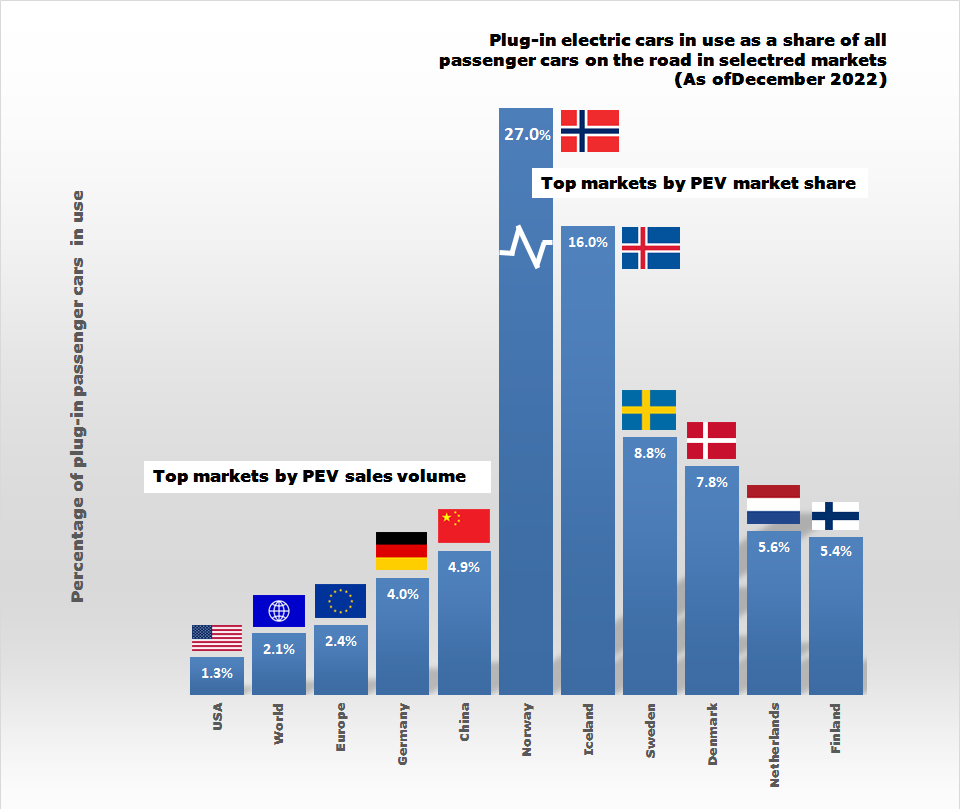
One country is disincentivizing or even blocking renewable energy production, rolling back climate protection measures, trying to revitalize the coal industry, slashing investment in scientific research of all kinds, demonizing higher education, and spending vast and rapidly increasing amounts of public funds to create direct, physical conflicts.
Another country is increasing their renewable energy generation capabilities dramatically each year, encouraging EV adoption, investing very heavily in scientific research, and also investing in military (although without initiating direct physical conflicts).
One of these two countries is riding on momentum, but the drag from waste and mismanagement of resources is increasingly slowing it. The other country is building momentum while reducing drag.
The difference in these approaches will be obvious in a decade, and in two decades one of the two countries will be just another chapter in a book about the rise and fall of empires.