Good read, and touches on a lot of the pain points from that era. As someone who was lurking on HN at the time during the containerization boom, I think that the key failing of dotCloud/Docker was not capitalising on Docker Swarm almost immediately. Docker Swarm was touted almost from the start but the repeated delays gave it a reputation of smoke and mirrors left people scrambling for solutions.
I also clearly remember the multiple high profile spats that 'shykes had on HN which burned a lot of bridges. At the time he had a reputation for answering lots of questions on HN which helped a lot with community building. After those bridges were burned there was no one to speak for Docker as the developer mindsets shifted slowly towards Kubernetes. IIRC the Github PRs were also a source of contention as dotCloud corporatised.
To be fair, Kubernetes was a real slog to understand at the start and had a lot of competition; it was definitely not the same level of simple, direct technical solution that Docker was.
Interesting trip down memory lane and what a pivotal technology! Regardless of the rest Docker is a true cultural phenomenon and a testament to the insight of the creators working outside of the myopia of big tech.
Yes. Anyone who wants to relive an early ignition of one bridge should read the HN thread on the Rocket announcement.[0] No one is sympathetic with respect to the Rocket/Docker spat; both companies behaved poorly -- and it was increasingly clear that the energy at Docker, Inc. was going to spent fighting others rather than building a business.
Speaking personally, the fate of Docker, Inc. was clear to me when they took their $40M Series C round in 2014. I had met with Solomon in April 2014 (after their $15M Series B) and tried to tell him what I had learned at Joyent: that raising a ton of money without having a concrete and repeatable business would almost inevitably lead to poor decision making. I could see that I was being too abstract, so I distilled it -- and I more or less begged him to not take any more money. (Sadly, Silicon Valley's superlative, must-watch "Sand Hill Shuffle" episode[1] would not air until 2015, or I would have pointed him to it.) When they took the $40M round -- which was an absolutely outrageous amount of capital to take into a company that didn't even have a conception of what they would possibly sell -- the future was clear to me. I wasn't at all surprised when the SVP washouts from the likes of VMware and IBM landed at Docker -- though still somehow disappointed when they behaved predictably, accelerating the demise of the company. May Docker, Inc. at least become a business school case study to warn future generations of an avoidable fate!
I worked at A Thinking Ape (another YC alumni), and for the longest time we had people beating down our door to invest, but the founders always told us why they weren't going to take it: we didn't need money. We had money to run the business, but we didn't have a handle on what we would do with $10m or $100m. What do we need to do to get more users that stick around and generate profit? More and better advertising? Sponsoring YouTube content creators? Hiring 50 more developers? Acquiring other companies?
Without a clear idea of what specifically you need to spend money on, and how specifically you are going to spend that money to generate growth and value, taking money is a bad idea. And if the answer to that question is "so that we can keep paying our developers", then you're probably already doomed.
I remember having a ton of sympathy for CoreOS, Docker really was hard to integrate with as someone doing sysadmin automation stuff.
Docker went to war with the standard Linux init system and the kernel developers who maintained cgroups, their core system primitive. I don't really understand how that was supposed to work out.
I honestly feel that they were both pretty unsympathetic. In particular, CoreOS timed their Rocket announcement for the moment at which the Docker team was airborne en route to DockerCon Europe 2014. It was very petty -- to say nothing of the petty naming (clearly a play on "Docker") or the generally antagonistic approach. None of this is to forgive Docker, who was equally petty in their response -- and a sign of much more pettiness to come, sadly...
> CoreOS timed their Rocket announcement for the moment at which the Docker team was airborne en route to DockerCon Europe 2014
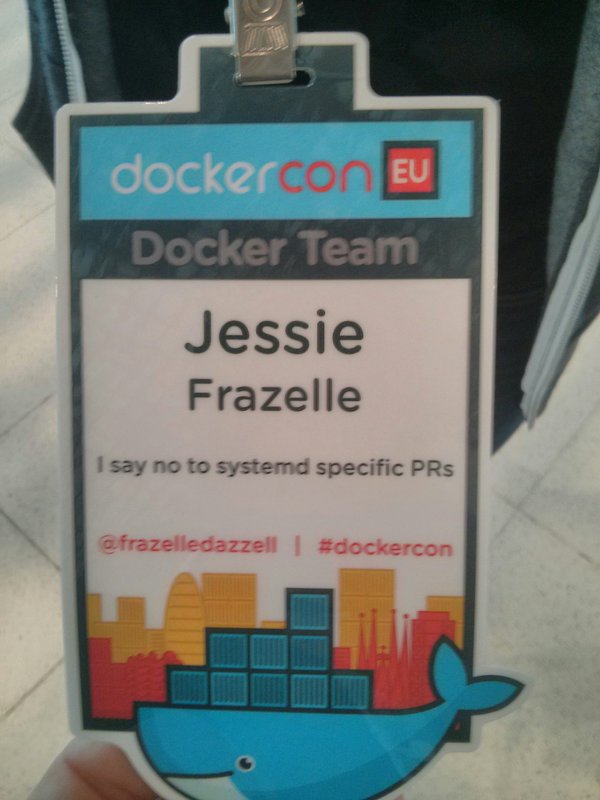
Would that be the conference where Jessie Frazelle wore this telling gem of a troll badge? [0] If so, the parent article [1] says it was 2015.
I was actually present at CoreOS during this period, and played a significant role in the early rkt releases. There's no prominent memory of timing the announcement to coincide with Docker people being on a plane, I think we were just rushing to get it out by dockercon and the en route thing is a coincidence. Rkt didn't just appear out of nowhere overnight, we had to build it and making something like that actually work reliably as a standalone executable without installing a daemon on arbitrary distros is a bit of a chore.
Early CoreOS employee and involved in all of the launch conversations around this...I can confirm there was absolutely no talk of travel plans or catching them at a bad time or anything of the sort. It simply had to get shipped before the conference started so we could talk about it.
No, it was DockerCon EU, December 4-5, 2014 -- and the Docker folks very much believed that it was deliberately timed to their flight several days prior. Unknowable now as that may be, there is no question that Rocket took deliberate aim at Docker -- and timing its announcement to upstage DockerCon is frankly only marginally less petty than timing it to a transoceanic flight. Lest I be seen as defending Docker, Inc. or DockerCon: this is also the only conference that removed a presentation of mine because they didn't like presentations that had more views than their keynotes. So Docker Inc. very much made their own bed, and I understand how Alex and CoreOS got to the point they got to -- but it doesn't mean that they were any more sympathetic in the resulting spat...
Rkt took deliberate aim at the problem of reliably running docker containers as systemd services, and as one of the early rkt developers I can honestly say I did so grudgingly after various meetings convincing me we had no choice.
If the Docker folks hadn't deliberately obstructed our ability to reliably run Docker containers as systemd services, none of this would have been necessary. We certainly had better things to spend our time on.
Not sure, I was no longer involved when those changes were happening.
What I can say is there was a lot of change in the container landscape at the time. Kubernetes flipped the script, Fleet from CoreOS was deprecated, and my guess is amidst the consolidation happening around Kubernetes and the CNCF, rkt became less relevant and just didn't find a permanent home.
Flannel, Fleet, Rocket... does anyone use any of this stuff still? "Move fast and break things" tends to leave a trail of waste in its wake.
> raising a ton of money without having a concrete and repeatable business would almost inevitably lead to poor decision making
This for me is one of those "I feel like I'm taking crazy pills" lessons. It seems so obvious to me, and I hesitate to even estimate the vast amount of cash wasted in the last decade like this. But it's a lesson that an awful lot of people seem to insist on learning for themselves. Or not!


I also clearly remember the multiple high profile spats that 'shykes had on HN which burned a lot of bridges. At the time he had a reputation for answering lots of questions on HN which helped a lot with community building. After those bridges were burned there was no one to speak for Docker as the developer mindsets shifted slowly towards Kubernetes. IIRC the Github PRs were also a source of contention as dotCloud corporatised.
To be fair, Kubernetes was a real slog to understand at the start and had a lot of competition; it was definitely not the same level of simple, direct technical solution that Docker was.
Interesting trip down memory lane and what a pivotal technology! Regardless of the rest Docker is a true cultural phenomenon and a testament to the insight of the creators working outside of the myopia of big tech.