We get rid of it, Google/Facebook/etc. shut down. While social media is of arguable benefits, Google has provided incalculable value to the world. Ads are the magic money fountain that give them the power to organize all of human knowledge, a phenomenal resource anyone can tap.
Wikipedia provides more value to me than Google, and it doesn't rely on adverts.
And static websites with mostly text are very cheap to host now, and there are lots of people willing to share their knowledge without adverts. That was how it was usually done before the rise of web advertising, and old-fashioned websites still exist. You don't even need search engines to find them; there are volunteer-run directory projects like Curlie (successor to Open Directory Project and DMOZ).
Bloated websites full of video and megabytes of Javascript are probably too expensive to host without adverts, but I think the web would probably be better without them. I'd miss Youtube, but how many Youtube videos are really the best way to present the content and a good use of your time? A non-commercial web is possible.
Wikipedia almost goes under every year if their banners are to be believed. They have to beg for money to stay open. That's not a ringing endorsement of an "ad-less" model.
They're going to shoot themselves in the foot doing that. Eventually people are going to stop donating as people become more blind to the donation drives.
As the article itself mentions, ads are not inherently bad.
When justified, it's a way for a company X to say "hey, I've this product Y that does Z", informing the market.
However, things go south very rapidly in our world, and is far from this simple honest task of informing the market.
Wikipedia banner falls more or less in the honest category. It's even slightly better as the population "paying" for the product (through gifts) are already using it, and know its quality and its flaws.
Sure, but last I checked Wikipedia doesn't advertise itself outside of its own domains, nor does it actively spy on you with those ads wherever you go throughout the World Wide Web.
Still, I'm trying to imagine what the web would be like if every site that currently does the "bad kind of advertising" put up guilt boxes instead. For one thing, Wikipedia would probably disappear, because all the other sites are competing for people's limited altruism.
Pegging the viability of a searchable index to ad revenue is a deeply perplexing move.
The technology to run and maintain a web index is not new. Paid indexes have existed in specialized domains (academia, law, news) for decades.
Wikipedia is a vast, self-indexed resource supported by donations. It's also indexed by Google, and it's availability over the public internet makes them (Google) an enormous amount of money. The labor of creating Wikipedia (the actual labor of organizing human knowledge) was done for free, and the maintenance of Wikipedia is funded by donation.
Every paid ISP prior to Google maintained its own index, which was paid for by user fees.
Expert communities (which often can't depend on commercial indexes) maintain encyclopedic curated sets of links.
The internet - a vast decentralized web of self-published information - is what people want. It drives people to the internet in droves. One strategy for capitalizing on that hunger is to index everything, offer a pretty good index for "free," then sell access to those eyeballs. It is far from the only way to make the internet more accessible.
The only thing I use google for right now is a glorified phone book, because I'm too stupid to remember urls and too lazy/forgetful to bookmark them. So sometimes (sadly), I'll google the twoplustwo forums for poker, or "hacker news" because I forgot news.ycombinator.com. But it's the expert communities that I want, not Google's inscrutible index.
No one has really succeeded in substituting attentional transactions with actual micro-payments, but it's certainly not impossible. There's obviously a demand.
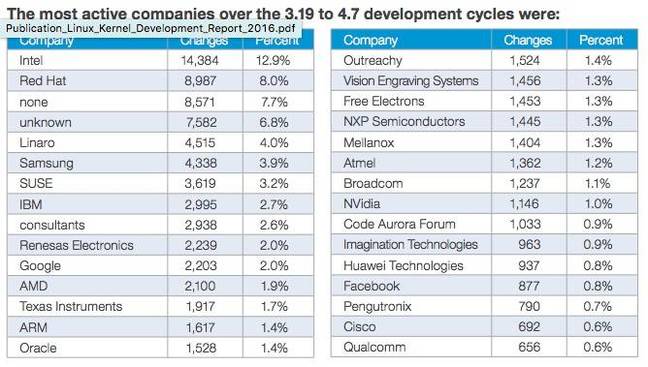
If projects as large as Linux or Wikipedia can thrive without ads, I'm sure a Google-quality search engine can do the same. So far it hasn't been done because the ad-supported model is promising more money to anyone who tries; but if the ad-supported model goes away, you'll see a good non-ad-supported search engine soon enough. It could be P2P and free (like Mastodon, which proved that social networks don't have to rely on ads), or it could be paid (like your Windows license or your internet connection).
The Linux Foundation's sponsorships are technically ads. Not particularly intrusive ads, so I generally don't mind them (much like I don't necessarily mind sponsorships of other things, like sports arenas and NASCAR drivers), but still ads nonetheless.
Seems most of the contributions are from hardware/distro developers. Recent contributions pin Google at making up about 2% and Facebook at 0.8%. I can imagine they're contributing far more value with their Linux Foundation memberships though.
Fair enough. But, that still means that most Linux contributors are not doing it out of the goodness of their hearts and that they are getting paid for it - not volunteering.
Plenty of otherwise-viable business models can't compete with free-but-spying. Hell, open protocols with free implementations aren't having much success. Just not enough incentive to use them, which lowers incentive to work on them, causing a feedback loop that keeps them from improving much.
If people value it then at a certain point they’ll pay for it. What we might find out however is that a lot of these free services aren’t valued and no one will pay for it. And I think that just reinforces the point of the article: those services are cancers, literally no one values them, they’re just manipulated into using them.
Things like search engines will be able to survive because they’re necessary. They may look different (e.g. wrapped up in a subscription package with gmail and gdocs). We are used to paying $X per month for an internet connection, it’s absurd to believe people won’t add on $Y per month for the over the top services that make that internet connection useful.
That sounds fairly alarmist. I'm sure there's a (small) subset of users who'd be willing to pay for services like those if there weren't any creepy advertising tricks happening in the background. Would the business model change? Certainly. But shut down? Probably not.
Google/Facebook are big and motivated enough that they could probably figure out how to make money.
And regress to a world where access to the best tools and information is denied to those who can't afford it? No thanks. I consider the alignment of profits with breadth of access to be one of the biggest engines of progress in the modern age.
But we've always gotten the milk for free. In fact, the milk has gotten better and better, they're also offering cheeses, yogurts, and steaks. Why would anyone start paying now?
I know why (privacy and ethics), but most people won't and don't care.
> Google has provided incalculable value to the world
I'm not convinced by this statement, and I'd be genuinely interested to hear your reasoning behind it. Is it specific products? Specific technologies? Although Google has built some interesting stuff, I can't think of anything off the top of my head that they've done that was either a) something that couldn't have been invented without them, or b) only unique due to their ability to scale it out, rather than a true innovation.
The problem with arguing your viewpoint is that no one can prove something wouldn't have been invented without Google. So, no matter what is listed, you can just say "someone else might have invented that".
And regarding your second point, what would the practical difference be to the consumer if the innovation happened because of their ability to scale out, or "true innovation"?
You don't need to like Google to admit they have added value to the world.
You may be assuming you know my viewpoint without me having presented it in full, but anyway I wasn't looking to argue in bad faith, I guess I just see a strong difference between "successful company that has made money and cool products" and "added incalculable value to the world." That's a very strong statement!
The parent comment was looking to weigh the problems of the ad-supported economy and the ills brought about by that described in the article against the value Google has brought to the world, and I just don't see how the two stack up, so I wanted to understand their weighting of the latter.
Everyone seems keen to write haigiographies of companies that in all honesty I mostly find ... okay I guess? Could do better but they make cool stuff? I don't "hate" Google, but I do think that a company the size of Google doesn't need such zealous defenders, it needs a critical society that pushes it to do better with the crazy resources it has, and one of those things is to examine the ways in which it's basic revenue model is harmful.
I didn't think you were trying to argue in bad faith, and you are correct that I had assumed you presented your full position in your initial post - my apologies.
And I agree, "incalculable" makes it quite a strong statement, and I probably wouldn't have chosen that word myself.
I think it's important to consider that Google is not the sole inventor, proponent, or user of advertisement. You probably aren't claiming that either, but the way your statement reads("problems of the ad-supported economy and the ills [...] against the value of Google") leads one to believe that you put those two things on equal footing. Google certainly evolved advertising, and is certainly a major player, but they aren't solely responsible. So, to weigh "Googles Good" vs. "Advertisements Ills" is hard to reconcile.
a) something that couldn't have been invented without them
Are you suggesting that order of magnitude improvements on information accessibility in a planetary scale is nothing?
b) only unique due to their ability to scale it out, rather than a true innovation
Scaling out search engine to the entire globe is THE innovation. You need to realize that any kind of innovation doesn't freely come from a bunch of idea guys, but from execution.
Google is the easiest thing in the world to sell ads for. You literally have a user telling you exactly what they're looking for. Why do you need to track them or do any of that shady stuff? When I search for "gaming laptop", just show me ads for gaming laptop. You don't even need to know who I am!
If they know more about you they can show you one at the top of your price range. Or maybe they know you like to finance things and they can show you a monthly payment. They could also show you one that happens to be your favorite color. Or if they know your political affiliation they can show you the limited "MAGA" model.
Nah I'm good, if I'm looking for "MAGA-themed pressure cooker" just show me a good one, I can refine my query myself and avoid giving you my SSN and bank details.
Your hypothetical is poorly considered. We'd find another way to fund it. Things that are of incalculable value generally get paid for.
And I'll note that Google, etc, only take a fraction of the money flowing through the ad system. So if we got rid of ads, we could not only afford Google, but a number of other valuable things of Google's size.
Good riddance; it's been most of a decade since Google provided anything of value to the world. They're ruining HTML with AMP, their sponsorship of YouTube has crippled torrent-based video distribution, their search engine is a sick joke, and ReCaptcha puts large chunks of the web behind a Kafka-shrouded spyware-wall.
Ok, great, it provided incalculable value to the world. At what point do we decide it is just existing as a barnacle and pumping money into making billionaires richer? How do we move past Googles dominant position and reclaim that monetary stream for better causes? Like you said, it is incalculably valuable, kind of like you might consider some public services to be.
So we split Google, Facebook, etc into two parts - content with no ads, and the "yellow pages" that are ads only, for when you want to go find product info.
2nd option... add a useful/not useful flag to every search result, so users can flag blogspam, content farms, etc and help keep the results useful.
Yes, it was. I can remember desperate attempts to look for specific documents that I forgot to bookmark on Altavista or Yahoo . It usually ended with going through all the indexed documents and finding nothing relevant. With Google, I usually find such documents within an hour.