I have always wondered why there is a transition between violet and red, if they are on opposite ends of the frequency spectrum. Despite that, they don't act like two extremes, just two positions on a "wheel". Why is color so wheel-like when the physics is just linear? What are we "seeing" when we see a violet-red? Why do we feel like violet is between blue & red?
There are three kinds of cones in the eye, and each frequency of light is absorbed at a different rate by each of them. So when your eyes see light of a given frequency your brain gets this information as three numbers, which you can visualise as points in 3-dimensional space. One of the directions in this space just represents brightness, so we can throw it away if we're only thinking about colour.
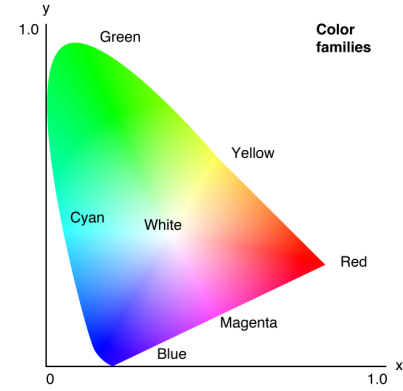
So the different colours are all points in a 2-dimensional space. Each frequency corresponds to a given point in this space. If you plot all the frequencies from the spectrum they form a curve in this space, which is a semicircular shape. Red is at one end of the arc, and violet is at the other.
But the possible colour aren't just the ones on this arc. We can also see colours that correspond to mixtures of different frequencies. These fill in the inside of the semicircle, creating the full space of possible colours, which looks like this (https://pbbhandarkar.files.wordpress.com/2016/10/colorspace....). The spectral colours are on the arc around the outside, and all the colours on the interior can only be made by mixtures. The line joining red and violet is called the "line of purples". It joins violet back up to red to make a circle, but it consists only of mixtures rather than spectral colours. The spectral colours don't go around in a circle, just a semicircle. We need the line of purples to join it back up.
Red receptors are somewhat sensitive in violet part of spectrum too. In standardized response curves it is omitted (I am not sure why), more details: https://midimagic.sgc-hosting.com/huvision.htm
My completely made up intuitive understanding of it is that it's the same as musical pitches; there are many versions of each named pitch e.g A through G that are each an "octave" away from each other. The difference between "Middle C" and the one above it is that the frequency of the higher version is exactly double that of the lower. As a listener the two notes sound extremely similar, the higher one just feels more "energetic" or something. I imagine colors would be the same if our eyes could see more than one "octave" but we are only sensitive to approximately one "octave" of light, ~ 480Thz-750Thz.
Given that, violet appears to be between red and blue in the same way the pitch of G appears to be between the pitches F and A.
Interesting! Although I don't think this means I'm completely wrong, just that there are "true/full violet" values that we can't see that would make the semi-circle that is visible light into a full circle if we could see a full "octave"; instead we are limited to seeing just violets that are mixes of other colors.